

TL;DR — A reader pointed me to an “Adaptive Hedge” sleeve: rank six defensive assets by momentum, hold the top two, and hide in cash when nothing is trending up. I rebuilt it in QuantMage — dropped SH, added more defenders, ranked by 250-day Trend Clarity, picked a top 3 — and it backtests to 10.1% CAGR with a 12.2% max drawdown over 18 years, at just 0.25 correlation to SPY. It even upgrades the defensive sleeve of my TQQQ timing strategy. Full disclosure: I tinkered a lot to get there. Data mining, or a hedge that finally earns its keep? You be the judge.

This post starts with a reader. After my last post on volatility-gated TQQQ, a reader shared this article as a potential risk-off sleeve for that strategy — thank you, whoever you are; this is exactly the kind of homework I enjoy.
The original recipe
The “Adaptive Hedge” ranks the six assets below by momentum — blended past 1, 3, 6, 9 and 12-month returns — rebalances monthly, and holds the top two in equal weights.

On top of that relative momentum sits absolute momentum: only assets actually trending up get selected, and if none qualify, the sleeve sits in cash. A textbook dual momentum setup. And in the author’s backtest, it earns a respectable risk-adjusted return:

Why I couldn’t resist
As regulars know, the “yieldy put” — a strategy that zigs while the market zags, yet still trends upward over the long haul — has been my white whale. I’ve taken my shots before, here and here, and a recent piece from a fellow systematic trader swims in the same waters. So of course I had to take the Adaptive Hedge for a spin in QuantMage.
📣 Quick note: This post is for informational purposes only, not financial advice. I’m not recommending any specific investment. Do your own research and consult a professional if needed.
What I changed (quite a lot)
After some trial and error, my version drifted substantially from the original:
Dropped SH. I simply couldn’t get a decent return — the “yieldy” part — with the inverse fund in the mix, so out it went.
More defenders on the roster. I added XLB (materials), IEF (7–10 year Treasuries), USIG (investment-grade corporates), and VNQ (real estate), and swapped DBC (broad commodities) for DBB (industrial metals).
Top 3 instead of top 2 — a little more diversification across the winners’ podium.
Two SHYs for the absolute momentum check. Padding the list with cash equivalents lets “none of the above” win when nothing is trending — a trick Keller fans will recognize.
Trend Clarity as the ranking engine. The 250-day version of Trend Clarity turned out to work beautifully as the momentum measure for these assets, replacing the original’s monthly-return blend.
20% threshold rebalancing instead of a fixed monthly schedule — trade only when the drift is worth it.
Full disclosure: most of these tweaks were, frankly, about achieving a better-looking chart (and numbers) while still reaching back to the GFC. So — did the plot get prettier?
The result
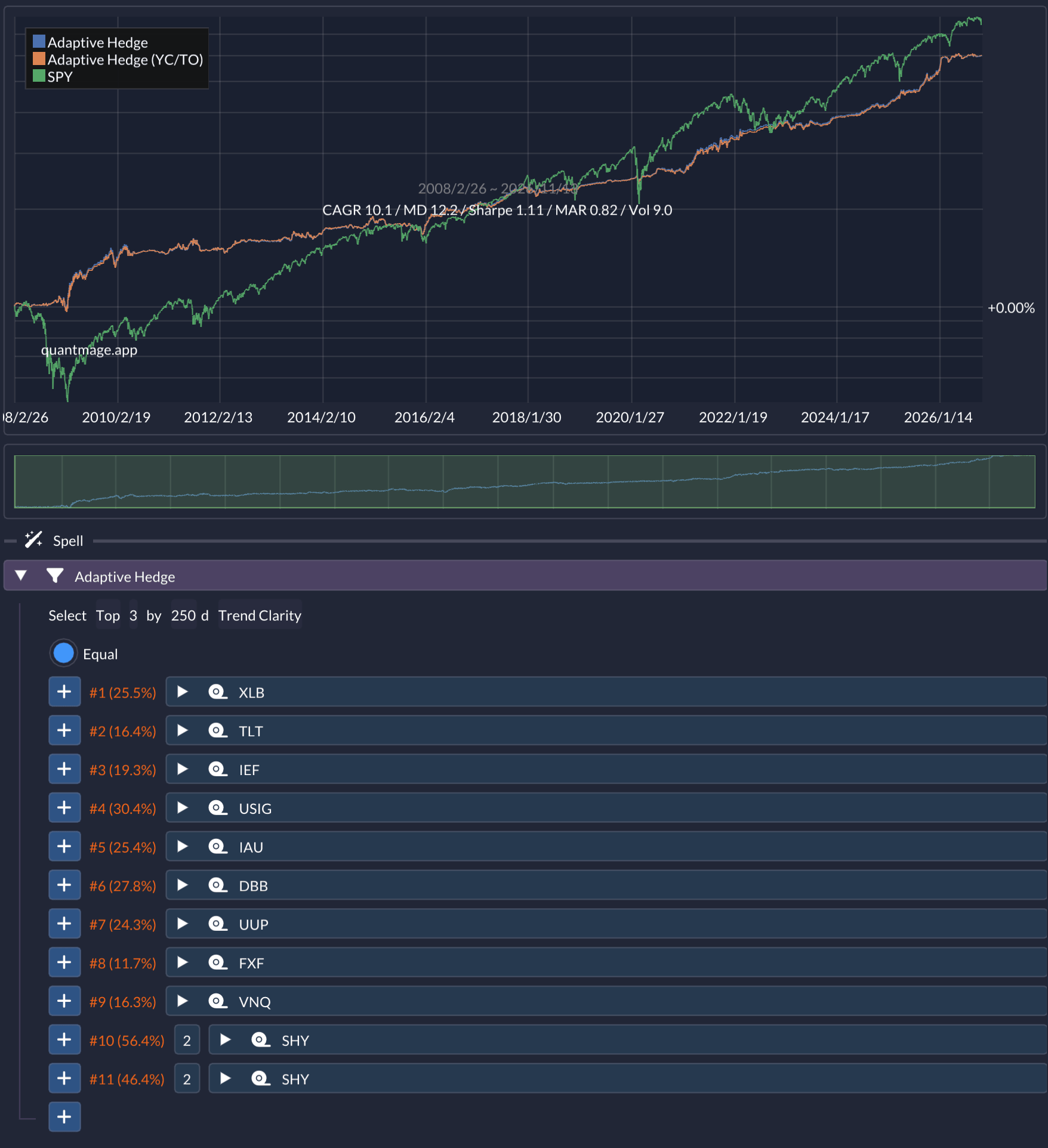
It did. 10.1% CAGR with a 12.2% max drawdown over 18 years — through the GFC, the euro crisis, COVID, and the 2022 bond rout. For a sleeve whose day job is defence, that’s a yieldy put earning its keep. Don't take my word for it, though — the spell itself is right here, so open it in QuantMage and put it through its paces yourself.
And the correlation to SPY? Just 0.25 — low enough to actually smooth the ride when equities stumble:

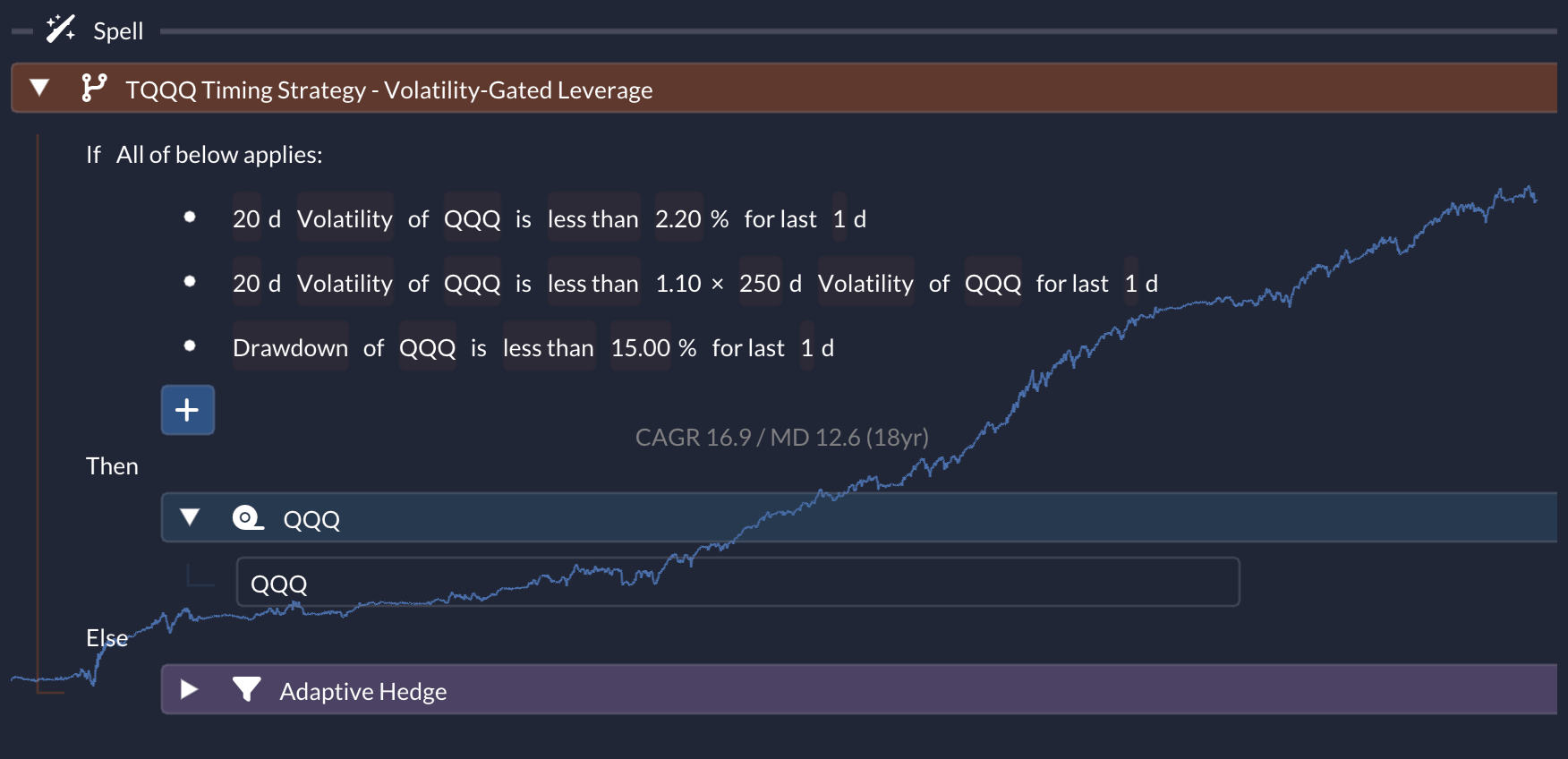
It also shines as the defensive sleeve of the strategy from my last post — here it is paired with an unlevered version of that strategy:
What do you think?
I’m tempted to add this either as the hedge sleeve of an existing live spell or as part of a new one. But let’s address the elephant in the backtest: that’s a lot of tinkering. Does it reek of data mining to you? And if you’ve found a better yieldy put — or a cleaner way to build one — I genuinely want to hear about it in the comments. This white whale isn’t landed yet.