

TL;DR: A white paper gates TQQQ behind a small stack of volatility and drawdown conditions, stepping down to a defensive sleeve whenever the market gets rough. I rebuilt it in QuantMage with a few pragmatic deviations. The result: a 45% CAGR over 16 years — paired with a 37% max drawdown that will still test your stomach.
Finally, a new strategy post! Yesterday I bumped into a neat white paper with a tactical take on an old question: how do you hold TQQQ — all that glorious triple leverage — without letting it blow up your portfolio when volatility spikes? Its answer: don’t ask whether TQQQ is “good” or “bad.” Ask whether the weather is right for it. The rules are relatively simple:
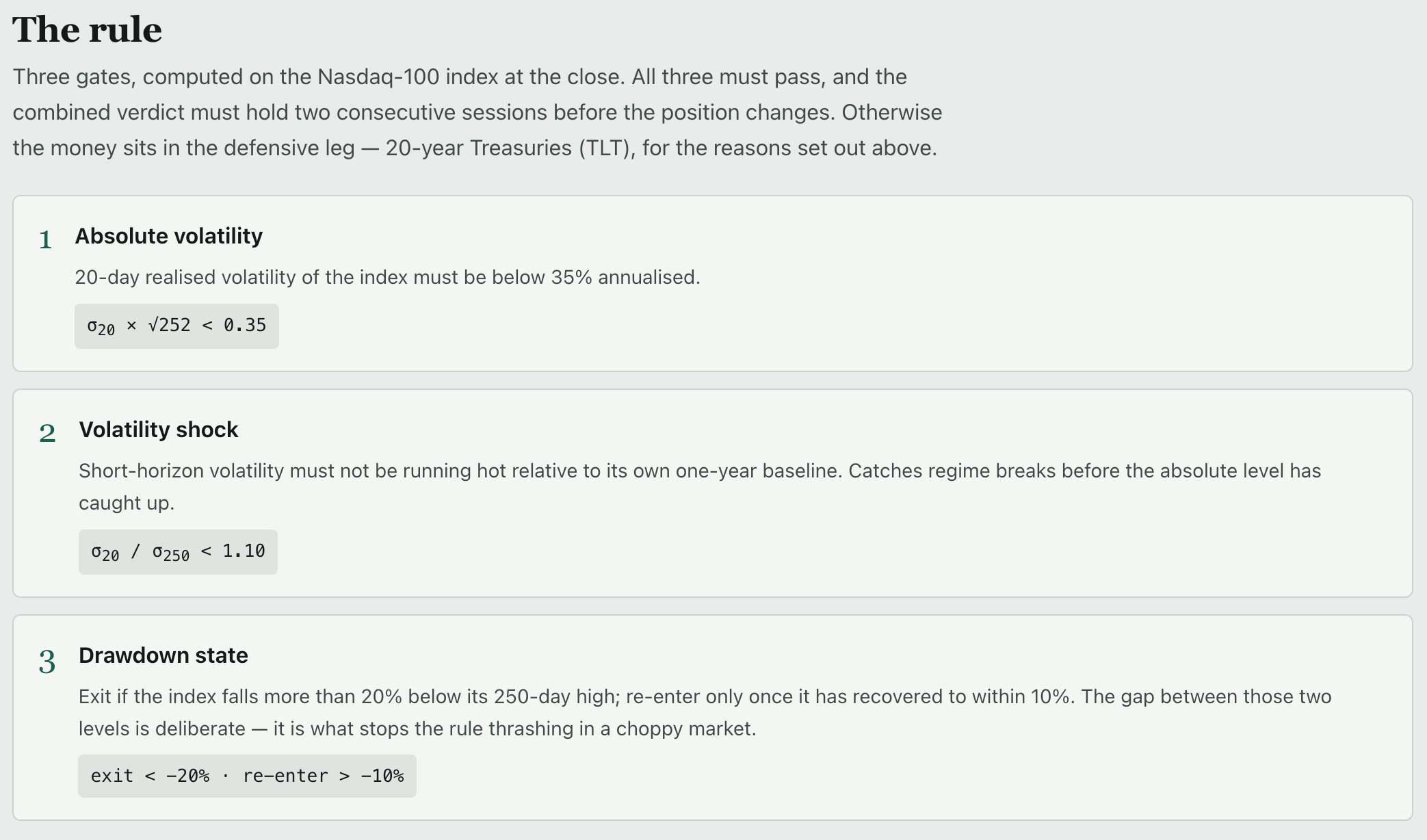
Three conditions stand watch. Pass them, and you’re in TQQQ. Fail them, and the strategy steps aside into a defensive sleeve until conditions clear. Naturally, I grabbed the QuantMage grimoire right away and tried to replicate it:
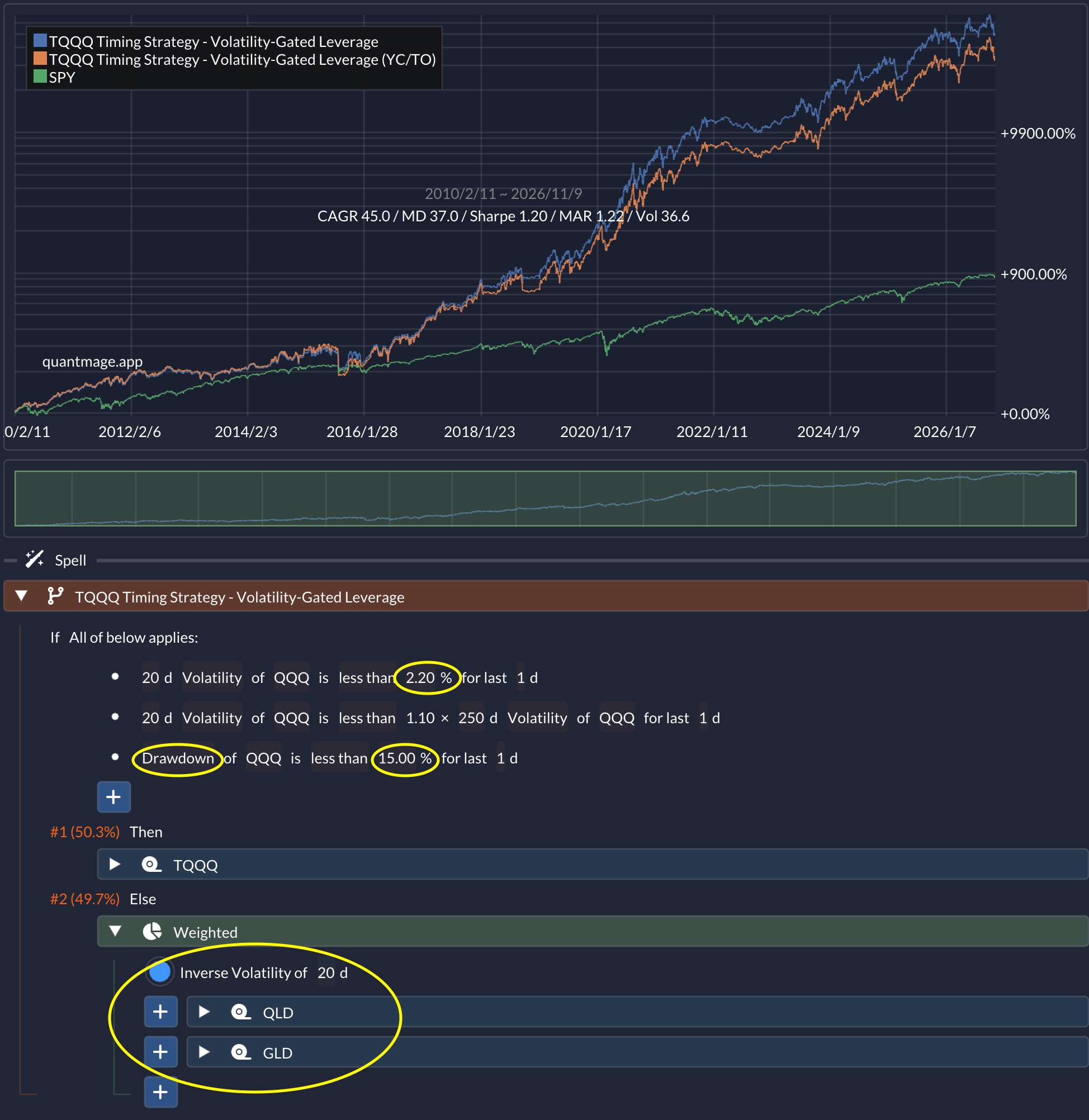
You can explore it further yourself in the grimoire.
Where my version deviates (and why)
A faithful copy it is not. A few pragmatic deviations crept in:
The defensive leg. Instead of TLT, mine holds a 20-day inverse-volatility-weighted mix of QLD and GLD. More on that choice below — I suspect it will raise some eyebrows.
The drawdown yardstick. The paper measures drawdown from the 250-day high; QuantMage doesn’t support that, so I used the all-time high instead. I also used a single 15% threshold for both entry and exit, rather than the paper’s 10% for entry and 20% for exit.
No two-consecutive-day check. The paper requires conditions to hold for two days running. I tested it both ways — and dropped it, because it made the outcome worse in my testing.
One thing that looks like a deviation but isn’t: the 2.2% in the first condition. That’s simply the paper’s 35% annualized volatility threshold, un-annualized — 35% divided by the square root of 252 trading days.
🚨 Disclaimer: This content is for informational purposes only and isn’t investment advice or a recommendation to buy or sell any securities. Always do your own due diligence and consider consulting with a financial professional before making any investment decisions.
The results
The headline numbers are hard to ignore: a 45% CAGR over 16 years. That’s the kind of figure that makes you sit up straight. But let’s be honest about the other number: a 37% max drawdown is probably too deep for most people — triple leverage gated is still triple leverage.
For the record, my numbers differ from the paper’s, and they should: the deviations above change the strategy, and the original also reaches further back by reconstructing pre-2012 data for TQQQ, which didn’t exist yet.
A longer-history sanity check
To see how the idea holds up beyond TQQQ’s lifetime, I swapped TQQQ for plain QQQ and set the defensive leg to cash:
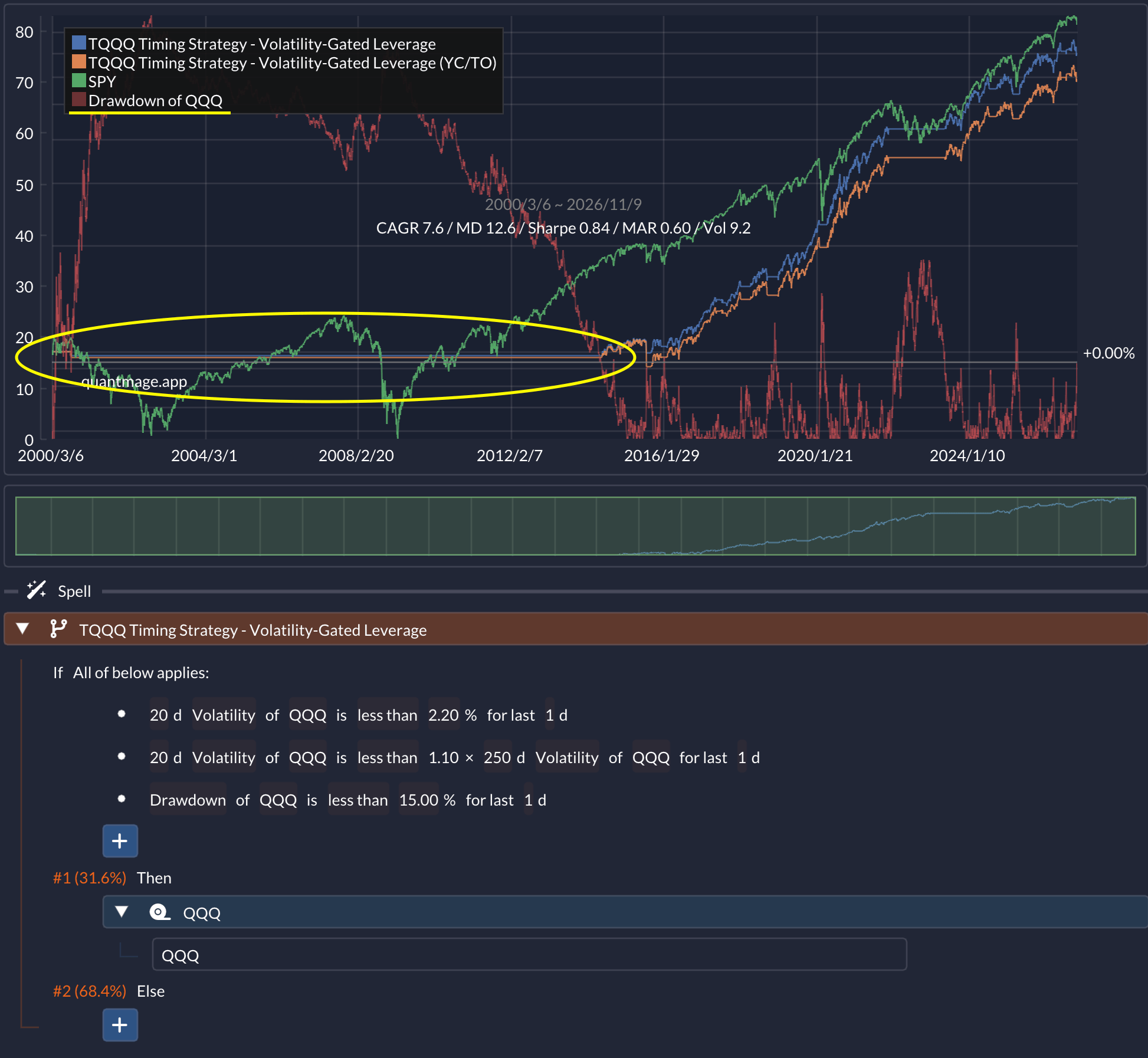
Now the history stretches to 26 years: a 7.6% CAGR with a max drawdown of just 12.6%. Both numbers come down a lot — no surprise, with a third of the leverage — but I’d still call that a decent result for such a simple set of rules.
One quirk worth knowing about, courtesy of my all-time-high substitution: because the drawdown is measured from the all-time peak, the third condition effectively stays switched off until 2014. The dot-com bust left such a deep scar that QQQ didn’t reclaim that high for well over a decade — you can see it in the drawdown chart above. A 250-day high would have forgiven and forgotten much sooner.
The white paper itself lists the original strategy’s limitations in noteworthy detail, so I strongly recommend reading it through before falling in love with the backtest.
Over to you
What do you think? Does a 2x-levered fund like QLD belong in a defensive sleeve at all — pragmatism, or a contradiction in terms? The original TLT may make more sense on paper, but it wouldn’t have been much of a haven over the last few years. Do you have a better idea for that leg?
Or, zooming out: do the stacked parameters — the volatility threshold, the 15% drawdown gate, the 20-day weighting — reek of overfitting to you?
Drop your take in the comments. I’d genuinely love to hear it.
looks very interesting! I like how, in contrast to many QQQ strategies, it takes the years 2000 bis 2003 into full account. I imagine the CAGR would be a lot better if it started in 2003.
No TQQQ strategy that can't easily handle the Dotcom bust is worth its salt, so that's where I'd begin. In fact, for robustness, I'd try to imagine an even worse kind of environment for tech stocks. Like, a few more drawdowns, and in addition have it go on a few years longer. One of my axioms is: something will always happen that has never happened before, so it's not good enough to perform reasonably well in a backtest. "Next time" might be a combini of Dotcom bust + Japan's 30 years of consolidation...
just in time! I just switched to 30% TQQQ sleeve in my IRA account.
I will review the paper and your strategy and run some tests to confirm if I should adapt the paper's strategy or your strategy or my current strategy which is quite simple.
as I trade manually I need a strategy that doesn't trade too often